
Digital Transformation
The structure of Digital Transformation
 Kaspar HaavajõeNov 26, 2024
Introduction
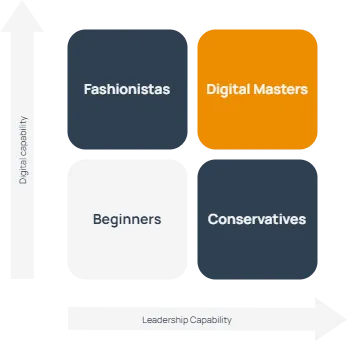
Digital Transformation is the use of technology to radically improve the performance or reach of an enterprise. One of the first statistical analysis about Digital Transformation of 391 different companies with different level of Digital success concluded that there are 2 principal dimensions that measure the success of Digital Transformation — the what of technology (Digital Capability) and the how of leading change (Leadership Capability).
Beginners have not adopted any digital technologies, nor have they properly led that change.
Fashionistas have aggressively adopted the technologies, but lack the leadership to give that technology any business context.
Conservatives try to lead a digital change without introducing new digital technologies.
Digital Masters excel in both dimensions. Digital Masters are 26% (EBIT margin) more profitable than their industry peers thanks to not only adopting new technology but also having Leadership Capability to manifest the change.
Digital Capability
There are 4 distinct components to Digital Capability.
Customer experience (CX) can be enhanced via digital technology by creating and communicating brand vision of the company, identifying customer touch points and creating cohesive personalized experience through many digital channels — social media, web, mobile, e-commerce. Additionally, digital feedback can be used for customer-driven innovation.
Operational processes can be digitally transformed by automating business core processes, changing the way employees work, creating real-time transparency, and making informed decisions.
Business model — what you sell, how you sell and how you make money from it — can be reinvented by digital changes. Physical products and services can be replaced with digital equivalents (e-services, e-commerce). Industries can be reinvented using shared economy concept (Airbnb, Uber, Bolt), enabled by digital technology.
Digital data platform is a prerequisite implementation to enable all the beforementioned components.
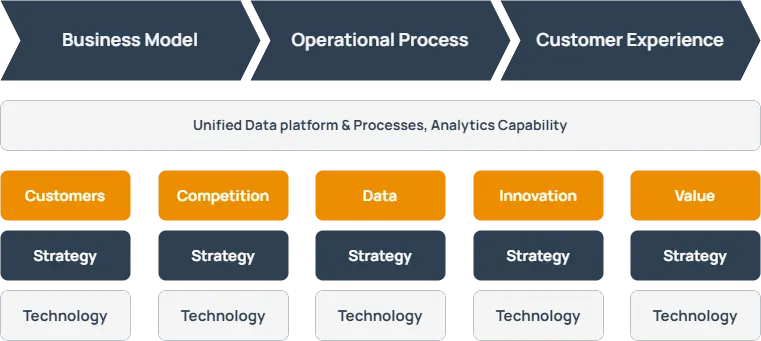
Specifically, there are 5 distinct domains of digital transformation that, by using effective Digital Strategy and corresponding Digital Capability, can be used to digitally transform the business.
Customers are not any more static set of consumers, but have a two-sided relationship with the business. An effective Digital Customer Strategy is to identify all the customer touchpoints and make use of technology to create more value. Access to your product or service can be improved by having omni-channel experience (web, mobile, cloud, in-demand service). Customers can be engaged by thinking like a media company and earning attention of your audience. Personalized experienced can be provided by recommendation systems and personalized products, content and offerings. Likewise, customers give an active feedback to the business by writing reviews, engaging with the product and producing behavioral data for analytics.
Competition is highly related to cooperation in Digital Age due to the rise of Platform Business Model (Airbnb, Bolt, Uber). The Digital Competition Strategy is either to build a store or a marketplace. Due to the scalable nature of technology (cloud, big data, analytics) it is possible to provide value on a multi-sided platform by leveraging the platform for your business case. The platform usually provides simplicity, standardization, cooperation for the rivals to “grow the pie” while the rivals compete with each others to “divide the pie”.
Data has become the king. The rapid development of new capabilities for managing and making sense of this has been shaped by the rise of cloud computing, which makes the potential of big data accessible. The Digital Data Strategy is to put data in the cloud in service of innovation and value creation by warehousing, parallel processing and training models for machine learning and natural language processing purposes. At the same time data strategy must take into account the legal, risk management, and data security.
Innovation is the process by which new ideas are developed, tested and brought to the market by businesses. Digital Capabilities enable rapid experimentation. The Digital Innovation Strategy makes use of both — exploratory learning (divergent experiments) and confirmatory learning (convergent experiments). Divergent experiments are focusing on minimum viable product and iterating continuously — being open minded with minimal cost and maximum learning. Convergent experiments are used for hypotheses testing using A/B testing, multivariate analyses on analytics data between test and control group.
Value proposition of the business is threatened by emerging technology. As digital technology is empowering customers’ options, it’s important for the business to react accordingly. The Digital Value Strategy is to re-iterate the value proposition of the business in the light of new emerging technologies and adapt. It means to proactively identify key customer types, existing value provided, emerging threats, potential new value generated and generation of new value proposition that has hopefully turned the threat into opportunity.
Digital Leadership Capability
Similar to Digital Capability there are 4 distinct components to Leadership Capability.
Digital vision is a seed that is planted at the top of the company engaging people at all levels to make the vision live and grow. It is the cornerstone of a successful Digital Transformation. Digital Masters have transformative digital vision. They are aware of current threats and opportunities in their industry. They share the vision, make it focused on business, not technology and are aiming this to be transformative while specific.
Engagement is needed to create a source of inspiration and crowdsource people to co-create solutions using collective intelligence. Leading by example, setting expectations and recruiting believers to join in. Focus should be on the critical conversations to solve business problems, not on tools themselves. Practical outcomes are trainings, hackathons, content moderation, scorecards with key performance indicators, a digital roadmap.
Digital governance is needed to iteratively coordinate and share the initiatives across the company. It means prioritizing and aligning practical initiatives and common resources across the company. Someone must be placed in charge of leading a Digital Transformation (e.g. CDO, CTO). A suitable governance mechanism is decided — committees, leadership roles, business units, shared digital units.
Technological leadership helps to translate the digital vision into a vision of a technology platform as the foundation of Digital Transformation. Clean, well-structured digital platform contains data, data definitions, systems, DevOps practices, etc. Everything starts from building out the right digital skills to meet the requirements of digital economy, establishing a shared technical understanding, IT-business relationship, possible partnerships.

Summary
One of the biggest obstacles to Digital Transformation is the failure to recognize the need for change, the urgency. Businesses react to threats instead of shaping the future. It is understandable because it’s hard to orient in the middle of continuous technological hype.
On a high level Digital Transformation comes down to 3 following steps:
- Building awareness (threats and opportunities of the current industry)
- Building digital roadmap
- Establishing mechanisms to follow through the journey and sustain
When the starting point is clear — your position on the Digital Transformation Matrix — it’s time to create vision to become Digital Master. This vision must be shared and translated to roadmap of actionable landmarks while taking into account existing assets and capabilities. While engaging, explaining, aligning and sending signals it’s important to stop telling and start showing by finding quick wins to prove the concept. Finally it’s important to encourage informed risk-taking, learning to fail.